Draper Art History- By Mrs. Willda Beck
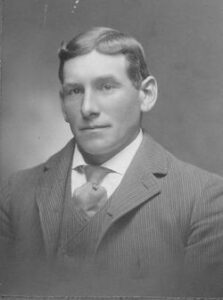
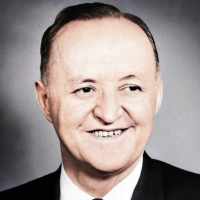
Mrs. Baker asked me to tell something about Reid Beck and the Art Project in this school. I know that I can’t mention names of all who assisted in this project; so in a general way I hope to give credit to each one.
This Art Collection as a real project was begun in spring of 1928. However, the portraits of John R. Parks, William M. Stewart and George Washington were hanging on the walls of the Draper School before that time.
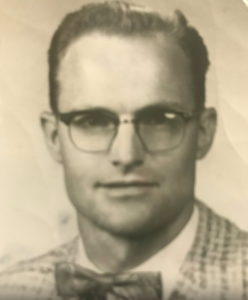
In 1917, School Board member J.R. Allen presented the school with two lovely enlarged photographs called “Sheep on the Hillside.” This was the year Reid Beck came from the school in Provo to be the principal of the Draper School.
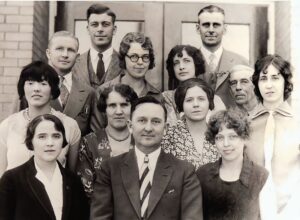
Mr. Beck was permitted to select six teachers from the Provo area to be hired by the Jordan District and placed in the Draper School. All of these teachers took an interest in art and each spring would visit the Springville Art Exhibit. At first it was more or less just a pleasant habit. Then later as the hopes and dreams of an Art Project began to change into action these visits took on more meaning.
I think that Reid’s first interest or love was people and his second love was art. Art was part of his makeup. But his painting was just a happy pastime or hobby. He did do a few watercolors for his home and for his friends. I have only one of his left and I love it. Loving art as Reid did it was only natural for him to want more pictures around him.
In 1928, he suggested that the Draper School start an Art Collection. These seeds fell in fertile soil, and it took little effort to interest teachers, pupils, P.T.A. officers, and some school patrons and businessmen in this project.
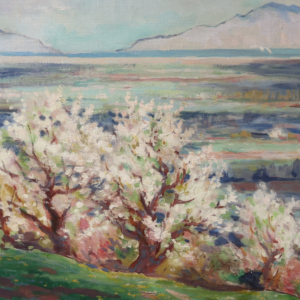
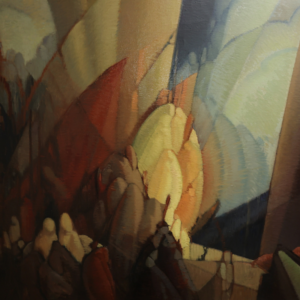
Mrs. Grace Rideout was President of the P.T.A. at that time and helped select the first picture. This picture was the first oil painting purchased. It is called “Spring Fancie,” and is of a peach orchard in Davis County done by Lee Green Richards. Richards is most noted for his portraits but has done many other lovely things. This picture was painted in 1926 but was purchased in 1928.
At beginning the Art Collection was to feature only Utah artists, but as the years passed and the project grew, more pictures and more artists were added to the list.
Sometime in the 1930’s, Mrs. Alice H. Horne introduced a bill in the State Legislature which authorized the formation of the Utah State Art Institute for the purpose of promoting young artists. So, Mrs. Horne was contacted and proved to be very helpful in bringing to our school many pictures for display and sale. From these displays some pictures were selected for our collection, and were purchased through Mrs. Horne and the Works Project Administration at a very nominal cost.
Back in 1954 on May 1st, the public responded to a Hobby Arts Fiesta Program which stimulated much interest. This project was conducted under the leadership of The Lady Lions. The general chairwoman was Mrs. Keeler and with her were Evelyn Cole, Effie Day, Frances Mickelsen, Marjorie Sorenson and of course many helpers. Such incidents as these are of great value in the development of any worthwhile program.
Superintendent Reed H. Beckstead followed Reid Beck as Principal of the Draper School, and during the year and a half that he was there he worked diligently to fan this light that had been started into a more brilliant flame. Two pictures were added to the collection: the two done by Cornelius Salisbury.
Then during the ten years that Mr. Keeler was principal, the project expanded and reached out to nationally known artists. Many of the most valuable and expensive pieces found in the Collection today were obtained in these years.
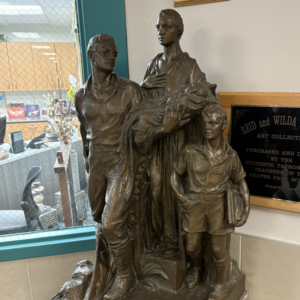
In the spring of 1955, it was decided to do something really outstanding. Mr. Keeler came out with the idea that if we went into it in earnest, we could own a statue done by Avard Fairbanks. A committee consisting of Jerome Brown, Max Hatch, Mary Sjoblom, myself (Willda Beck), and Mr. Keeler was selected, and Mr. Keeler made the contact. He got the appointment, but when we got to the studio we were met by the son of Mr. Fairbanks, who told us his father was in Italy, but that he would be pleased to show us around. We considered a Pony Express Statue and a Pioneer piece. We finally decided to take the Pioneer model. Mr. Fairbanks had made a piece from this model for another project, but he thought that he would be able to get permission to make another copy. So, we agreed to this and we made a down payment.
Mr. Keeler was then transferred to the Midvale Junior High and Mr. Gauffin came to Draper. Mr. Gauffin carried on admirably, working to raise money and keeping up the Art interest. At no time did he let Mr. Fairbanks lose sight of the fact that the piece had been promised and was expected.
In 1958, Mr. Gauffin was transferred and Mr. Hill came to Draper. Mr. Hill was very determined to obtain the piece, so Mr. Hill and Mr. Gauffin combined efforts. The visited the Fairbanks studio often but with the sculptor so busy and his being out of the country so often they found it to be a rather difficult problem. They then found that the sculptor had had difficulty in getting permission to copy the model that had been decided upon. So through the persistence of Mr. Hill and Mr. Gauffin and the desire of Mr. Fairbanks to make good his promise, this larger and more expensive one was offered and of course accepted.
Then their next step was to have it cast in bronze and again this was accomplished through their combined determination. This piece is now imperishable and very valuable. It has already found recognition for itself in Utah History. Its picture is in A. Hamer Reiser’s Sunday School Manual, “History of the Church for Young Children.” In this manual the picture is labeled, “The Mormon Pioneer Family.” These books are used in all parts of the world, from 1945 – 1960. Mr. Fairbanks calls the statue “The New Frontier” and now, thanks to all who assisted, the Draper Art Collection has this piece which is not equaled in any other school collection.
Just as important as the people who select the pieces of the collection are those who work to raise the money to pay for them. And of course this takes in many more than I could name here. But I must mention W.C. Vawdrey who gave much support to this movement and J.E. Mickelsen who also contributed generously to this cause. I well remember Reid coming home saying, “Joe said go ahead and raise what money you can and then come to me and I will pledge the rest.” And this was done several times. These men also assisted in selecting some of the pictures.
One of the moneymaking projects was selling school lunches. That was before the present lunch program (The National School Lunch Program was officially established on June 4, 1946 by President Harry S. Truman). Then there was the election of an Art King and Queen to reign over the proceedings, an Art Night, picture shows, dances, May Day activities and programs, and also substantial contributions.
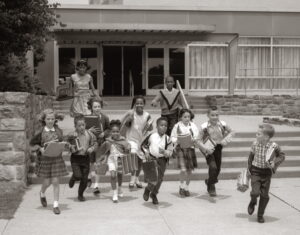
As long as the Junior High students were in Draper school these activities were carried on by the graduating class as chairmen and they were assisted by every pupil in the school. But each graduating class left a picture as its final gift to the school. And they often went in a body to the Springville Exhibit to choose the picture to be purchased. They were accompanied on these trips by teachers and patrons. When the Junior High was moved from Draper, the grade school took on this assignment and carried on with the Art Project, except that they planned to purchase a picture every third year instead of every year.
It was during the time that Superintendent Reed H. Beckstead was principal of the Draper School that they so graciously named this wonderful collection, “The Reid Beck Art Collection.” For the family I wish to extend our thanks for this great honor.
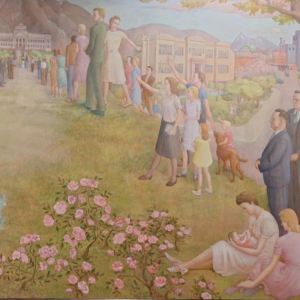
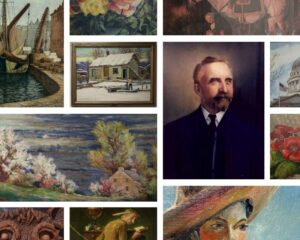
The collection is outstanding. It boasts of 53 pieces and it is recognized as one of the finest collections in the state. I hope that the pupils and patrons of the school will become better acquainted with both the pictures and the artists who are represented here in this gallery, and also that they will lend encouragement to the “would be artists” in this community.
May the spirit of art, which fosters culture and refinement, always be kept alive in the schools and in the town of Draper.
I thank you.
– Mrs. Willda Beck